Nothing I found describes a separate folding mechanism, so this covers the rotating cabinet shelf: a platform on a bearing that spins 360 degrees and brings back-corner items to you.
Door shape decides the fit, since a D-shape suits one diagonal door and a kidney 2 bifold doors. A 36-inch corner base usually takes 28–32 inches.
How a Lazy Susan Works

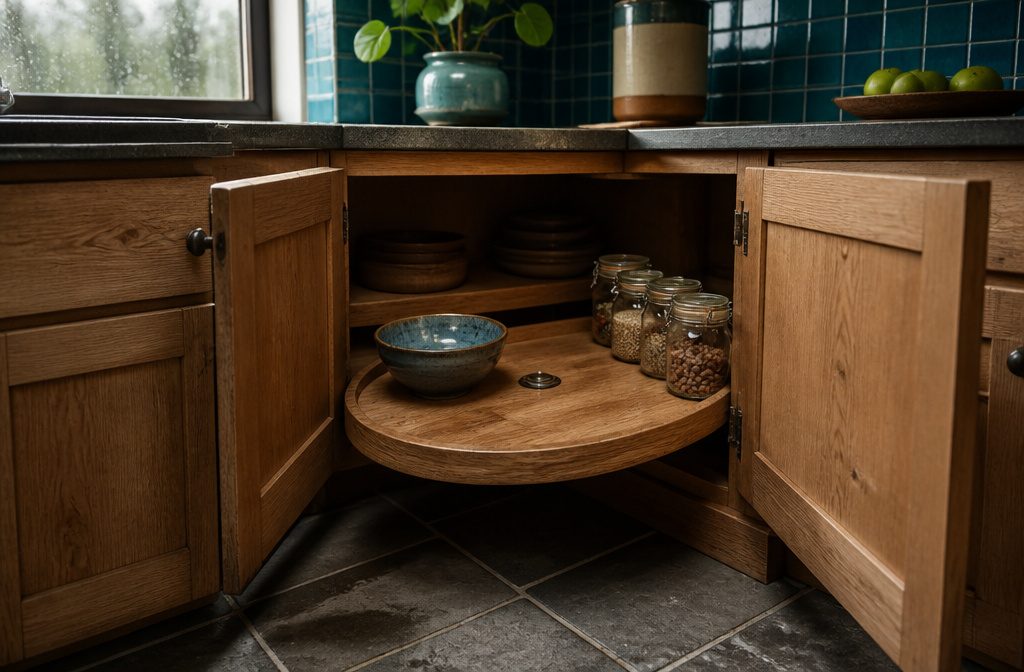
A lazy Susan is a rotating platform or rack on a bearing or turntable base, and it usually spins a full 360 degrees to bring stored items to the cabinet opening.
I haven’t found a distinct folding mechanism described for it, so this article covers the rotating cabinet version and doesn’t invent a folding one.
Bearings let the whole rack turn, while mounts or posts anchor it so it holds its position as it spins. That’s why it suits corner cupboards, where the back of the space is hard to see and harder to reach.
Instead of kneeling and shoving cans aside, you spin the shelf and the item at the back comes to you. Lower corner base cabinets are the usual home, though wall cabinets and pantries take them too.
Types and Cabinet Fit
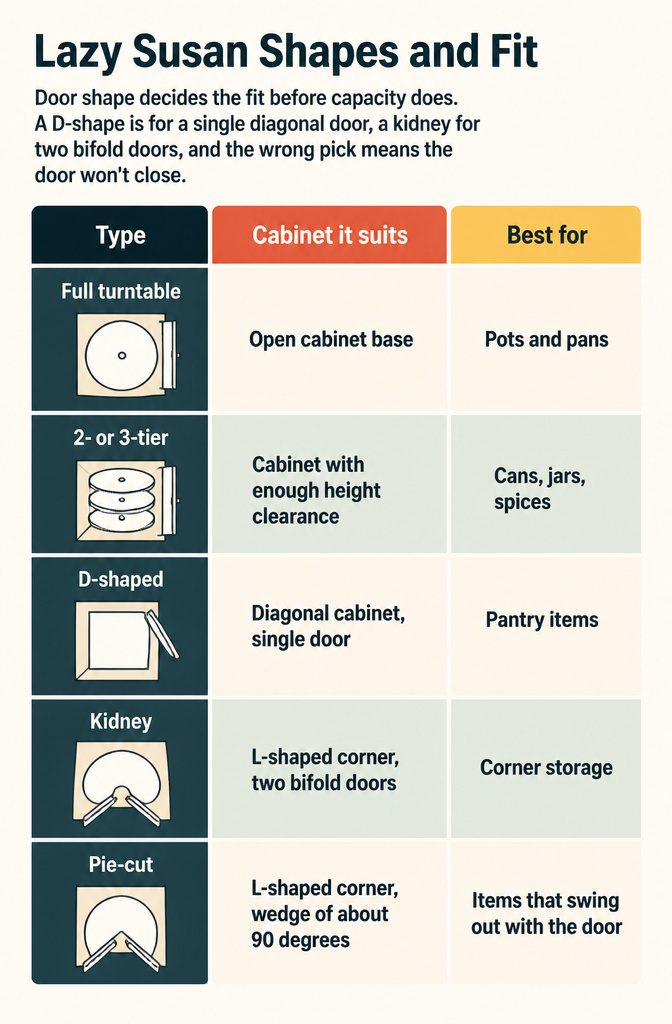
Door shape decides the fit before capacity does. A D-shape is for a single diagonal door, a kidney for two bifold doors, and the wrong pick means the door won’t close.
| Type | Cabinet it suits | Best for |
|---|---|---|
| Full turntable | Open cabinet base | Pots and pans |
| 2- or 3-tier | Cabinet with enough height clearance | Cans, jars, spices |
| D-shaped | Diagonal cabinet, single door | Pantry items |
| Kidney | L-shaped corner, two bifold doors | Corner storage |
| Pie-cut | L-shaped corner, wedge of about 90 degrees | Items that swing out with the door |
For an L-shaped corner, I’d choose pie-cut if you hate reaching, since the shelves ride out with the door.
Benefits and Trade-Offs

A folding lazy susan pays off in deep corners, where you’d otherwise reach blind.
Contents rotate into view, similar items stay grouped, and awkward space gets used. The biggest number is a vendor’s, so I read it as a best case:
Increase the amount of storage space in your corner cabinets by up to 50%
Expect less in a corner you already use well.
A round shelf in a square cabinet leaves unused corner gaps, and a hard spin can launch a jar, so pick a raised lip.
Cheaper polymer shelves carry less, and overloading makes them sag, wobble or spin unevenly; put the cast-iron pots on a sturdy wood model.
The same idea works in pantries, under sinks, bathrooms, garages, fridges and the center of a dining table.
Sizing Your Lazy Susan

Measure the inner width, depth and height of the cabinet before you buy anything, then work from these numbers:
- A 36-inch corner base cabinet usually takes a 28–32 inch diameter.
- A 33-inch cabinet likely needs a 24 or 28 inch model.
- Typical sizes run 24–32 inches. Standard sizes come in 33 and 36 inches, with custom as the fallback for odd openings.
- Subtract up to 4 inches from the cabinet width, and leave a couple of inches of clearance so the doors close and the shelf turns freely.
- Cabinet height decides how many tiers fit.
- Light spice organizers hold roughly 10–15 pounds. Heavy-duty tiers hold 50 pounds or more each, but check the manufacturer’s limit.
A wrong measurement gives you a turntable that wobbles or won’t rotate.
Installing and Caring for One
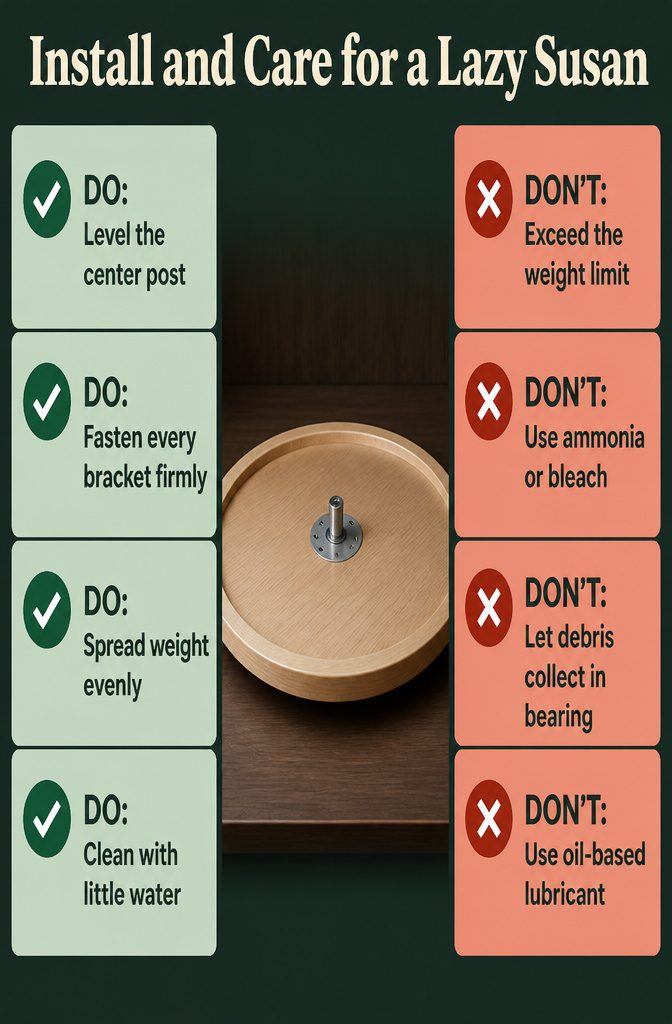
Level the center post before anything else. An unlevel post causes wobbling, scraping against the cabinet sides, and uneven spin, so set a level on it and check from a few angles before locking it down.
Work in a clean, dry cabinet, follow the model’s instructions, and fasten every bracket firmly.
Spread weight evenly across the turntable and stay under the weight limit.
Taller, heavier items go toward the center or the outer edge. Bins in plastic, wire, or wood subdivide the shelves.
Clean with a soft cloth and dish soap, using very little water, since too much can damage the wood and the mechanism. Skip ammonia and bleach.
Check the bearing for debris now and then. I’d use silicone lubricant only occasionally and per the manufacturer’s guidance; oil-based types attract grime.
Lazy Susan Materials
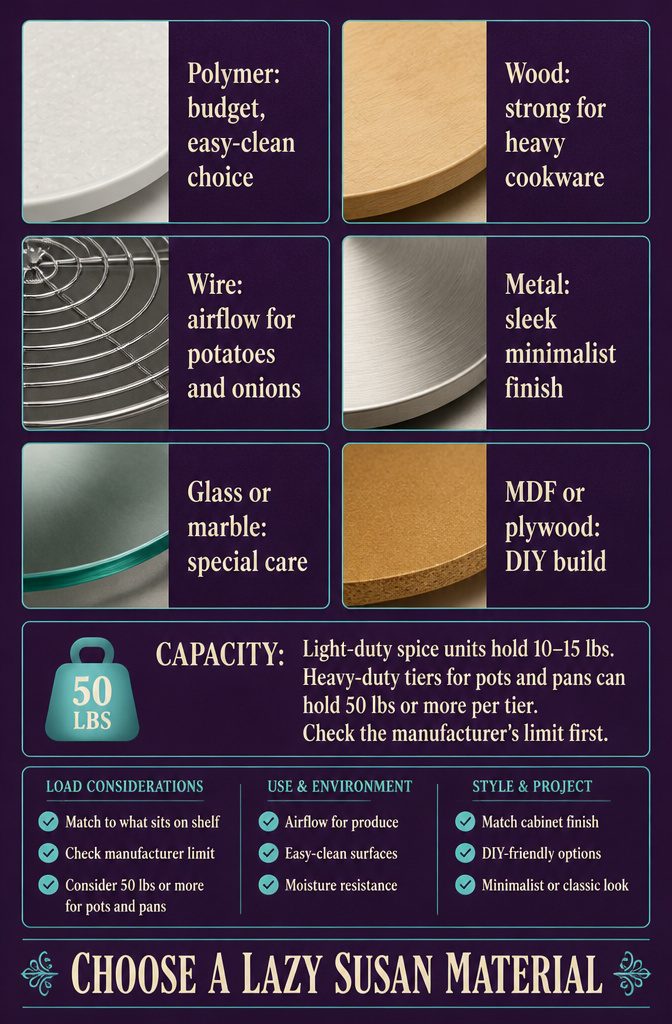
Shelf material decides weight capacity, cleanup and looks, so match it to what will actually sit on the shelf.
- Polymer or plastic: The budget pick. It wipes clean, and many shelves have a textured surface so jars stay put. It usually comes in white, almond or gray, which suits spices and canned goods.
- Wood: Maple or birch plywood is strong enough for a stand mixer or cast-iron pots. For heavy loads, it wins. Buy it unfinished to stain or paint to match your cabinets.
- Wire: Chrome-plated or coated steel lets you see the shelf below and lets air move, which helps potatoes and onions.
- Metal: Sleek and modern, best for a minimalist kitchen.
- Glass or marble: They look luxurious but need special care, so I’d skip them in a working kitchen.
- MDF or plywood: The usual choices for a DIY build.
- Capacity: Light-duty spice units hold 10–15 lbs. Heavy-duty tiers for pots and pans can hold 50 lbs or more per tier. Check the manufacturer’s limit first.
A DIY Version for $8
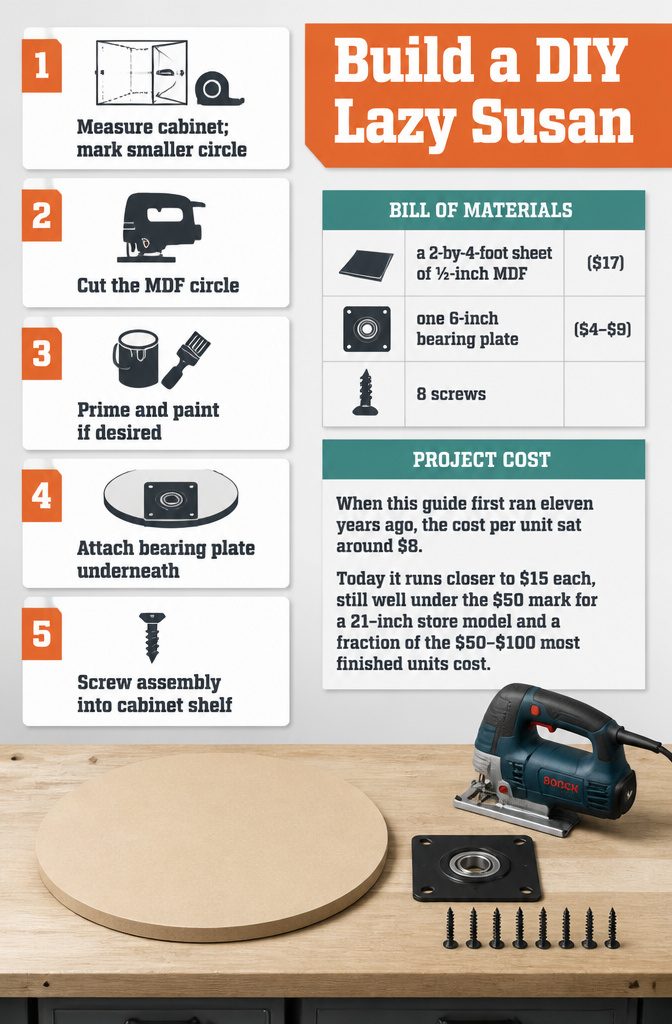
- Measure the width and depth of your cabinet, then draw a circle on the MDF slightly smaller than the opening so the finished piece can spin freely.
- Cut the circle with a jigsaw. A Bosch jigsaw is one good pick, though any clean-cutting jigsaw works.
- Prime and paint if you want a finished look. This step is optional, and skipping it keeps the project faster.
- Attach the 6-inch bearing plate to the underside of the circle. Use square bearings for cabinets; they cost less and sit stable. Round bearings are for countertops or tables.
- Install the assembly by driving a screw through each of the four holes in the bearing plate into the cabinet shelf.
The bill of materials: a 2-by-4-foot sheet of ½-inch MDF ($17), one 6-inch bearing plate ($4–$9), and 8 screws.
When this guide first ran eleven years ago, the cost per unit sat around $8. Today it runs closer to $15 each, still well under the $50 mark for a 21-inch store model and a fraction of the $50–$100 most finished units cost.
Lazy Susan Alternatives

Fixed shelving wins on price at $, but you reach deep into the corner and items get lost at the back.
Magic corner swing-outs win on access, since the whole unit swings out of the cabinet, yet they cost $$$$. I’d still pick a lazy Susan at $$ for round cookware, or a blind-corner pull-out at $$$ for boxes and cans.
| Option | Price | Access | Best for |
|---|---|---|---|
| Fixed shelving | $ | Poor | Tight budgets |
| Lazy Susan | $$ | Good to excellent | Pots, pans, round containers |
| Blind corner pull-out | $$$ | Excellent | Boxes, cans, Tupperware |
| Magic corner/swing-out | $$$$ | Superior | Heavy cookware |
| Full-extension drawer slides | n/a | Drawers pull fully out | Stable storage, nothing slides off |
| Rotating pot-and-pan organizer | n/a | n/a | Cookware; solid maple |
Frequently Asked Questions
What is a folding lazy susan?
It is a rotating platform or rack on a bearing or turntable base that brings stored items to the cabinet opening, usually through a full 360-degree spin.
A folding lazy susan has no separate folding mechanism; the rotating cabinet version is what you will find and buy. It is most often installed in lower corner base cabinets, and also in wall cabinets and pantries.
How does a lazy Susan work in a corner cabinet?
The shelf sits on a bearing or turntable base and turns up to 360 degrees, while mounts or posts hold it in position as it spins.
A gentle push swings whatever is stored at the back around to the opening. That means no kneeling or moving cans aside to reach the deep part of the corner.
How do I choose the right lazy Susan for my cabinet?
Start with the door shape: a D-shape fits a single diagonal door, and a kidney fits an L-shaped corner with two bifold doors. Then size it from the cabinet’s inside measurements.
A 36-inch corner base cabinet usually takes a 28–32 inch diameter, and a 33-inch cabinet likely needs a 24 or 28 inch model. Pick wood for heavy cookware and polymer for lighter items like cans and spices.
Are lazy Susans hard to install?
No. Most are made for DIY installation, and the skill level needed is low to moderate.
You measure, fasten the brackets firmly, and attach the turntable. Level the center post first, since an unlevel post causes wobbling and uneven spin.
How much weight can a lazy Susan hold?
It depends on the model and the shelf material.
Light spice organizers hold roughly 10–15 pounds, while heavy-duty tiers built for pots and pans can hold 50 pounds or more each. Check the manufacturer’s limit before loading it, because an overloaded polymer shelf can sag, wobble or spin unevenly.
Can I install a lazy Susan in a cabinet that isn’t a perfect corner?
Yes.
It also works in deep pantry shelves and under-sink cabinets, anywhere the back of the cabinet is hard to reach. Measure the width, depth and inside space first so the shelf fits and turns freely.