
A rotatable dining table has a spinning center so shared dishes travel to each guest instead of being passed. Most listings are wholesale, though, so check the minimum order first.
The Luxury Round Marble Top table, $249–$289 for 4–8 people, is the one sold as a single set. The motorized slate model runs $1,270–1,350.
Integrated Rotating Tables
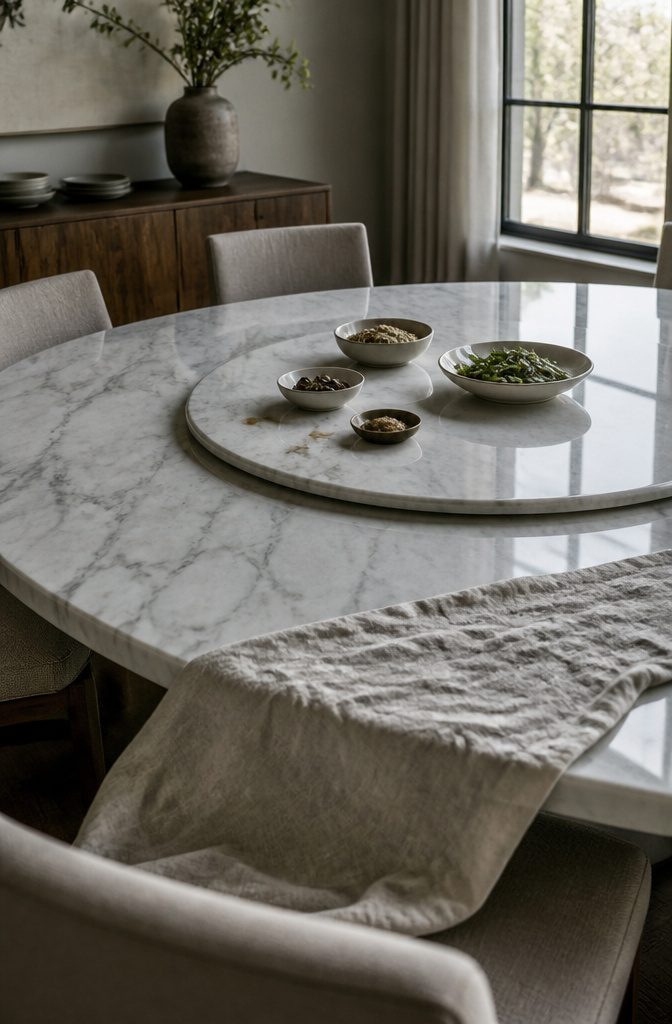
An integrated rotating table builds the turntable into the design, so the top and the spinning center are sized and finished as one piece.
For group dining and shared dishes, that beats a loose tray on a table never meant for it.
The Luxury Round Marble Top Dining Table is a good example: $249–$289, listed for 4–8 people, with 360° circular rotation and a minimum order of 1 set.
The marble top is durable and easy to clean, which helps on a table where gravy and soy sauce travel past everyone.
Listings sort these tables by shape (round, rectangular, square) and by extras like a built-in Lazy Susan, folding or automatic rotation.
A motorized slate-top model runs $1,270–1,350. I’d skip the motor unless you want silent, hands-free spinning, since a manual spin costs a fraction of that.
Standalone Lazy Susan

A standalone lazy Susan is a rotating tray that sits on a table you already own and spins on its own base, with no changes to the table itself.
That makes it the lowest-commitment way into the rotating idea: you keep the table you have and skip replacing it. For a renter, I’d start here before paying for anything built in.
The cost of that flexibility is a loose piece. It needs a storage spot between meals, and it has to stay centered, because a tray pushed to one side leaves some guests reaching and others crowded.
An integrated rotating table has neither problem, since the turntable is part of the top.
If you eat at the table daily, that permanence may win. For occasional big meals, the tray is easier to live with.
Materials and Their Care

For a family table, I’d pick sintered stone: it’s non-porous and resists scratches, stains and heat, and round tops are listed in 130cm and 150cm sizes for 6 to 8 people.
Marble looks richer but is porous, so it needs regular sealing and spills wiped fast. Wood and glass suit lighter use.
| Material | Look | Weak spot | Care |
|---|---|---|---|
| Marble | Luxurious, cool | Stains, etching | Seal regularly, wipe spills at once |
| Solid wood | Warm, classic | Scratches, moisture, warping | Polish or oil; keep liquids and direct heat away |
| Sintered stone | Modern | Heavy | Easy to clean |
| Glass | Sleek, light | Scratches, fingerprints, breakage | Wipe smudges, handle carefully |
| Metal | Industrial | Noise, scratches, dents | Damp cloth; polish stainless |
Rotation Mechanisms

A manual turntable has no motor, no cord and nothing to service: guests push the top and the dishes come around.
The Modern Luxury Revolving Marble Slate Top Double-layer Turntable is the version I’d point most people to. It pairs a round rotating dining table with a rotatable centre, so the dishes circle while the outer surface stays clear for plates.
It runs $210–$550, though the minimum order is 5 sets, which means a single home buyer should check smaller listings.
The automatic electric rotating table is a different class at $1,270–$1,350, also with a 5-piece minimum.
A motor turns the top without anyone touching it, which matters when a host can’t pass platters to 8 or more guests. For a home, the double-layer turntable is the better buy; the electric table pays off only in a restaurant.
Extendable Designs

Seating tiers sort these tables quickly: 4–6 guests for everyday meals, 6–8 for dinners with friends, 8–12 for holidays, and 12+ for events.
The Modhomi 6-seat extendable sintered stone round table runs $165–$185 with a minimum order of 2 pieces, which suits stocking several spaces more than furnishing one home. The foldable fire-pit table comes for 8, 10 or 12 people at $1,200, with a minimum order of 2 sets.
Extra capacity has a price: a larger, more complex frame adds weight, moving parts and storage needs. I’d buy the simplest extension that covers your usual guest count, not your rare maximum.
Supplier and Product Criteria
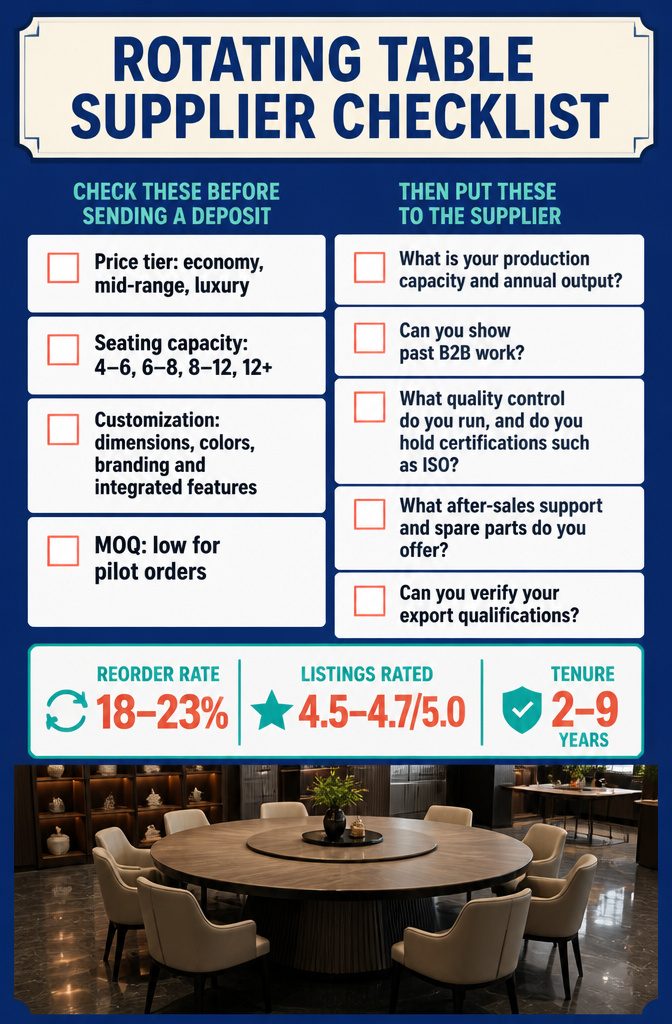
Check these before sending a deposit:
- Price tier: Economy, Mid-Range or Luxury. Settle this first, because it narrows everything else.
- Seating capacity: 4–6, 6–8, 8–12 or 12+ guests.
- Customization: dimensions, colors, branding and integrated features.
- Minimum order quantity: a low MOQ suits a pilot order.
- Rating, reorder rate and tenure: listings run 4.5–4.7/5.0, with reorder rates of 18–23% and tenures of 2 and 9 years. I weigh reorder rate above the star rating, since it shows buyers came back.
- Sourcing terms: FSC-certified wood or recycled metals.
Then put these to the supplier:
- What is your production capacity and annual output?
- Can you show past B2B work?
- What quality control do you run, and do you hold certifications such as ISO?
- What after-sales support and spare parts do you offer?
- Can you verify your export qualifications?
Bearings, Drives and Hardware

Ball bearings turn more smoothly and quietly than sliding bearings, so they’re worth paying for on a table that spins at every meal. Sliding bearings cost less and suit lighter, occasional use.
Motorized tables run on gears or belts. Gear drives give firmer, more precise control but run a bit louder, and they need lubrication.
Belt drives start more gently and stay quieter, though the belt tension needs an occasional check. For a dining room where people are talking, I’d choose the belt.
Metal matters too. Stainless steel and aluminum alloy both resist wear, but stainless steel is the better pick for humid rooms or tables that get wiped down often, because it resists corrosion.
Bearing design and metal choice also shape how much weight the top carries and whether it wobbles under a full set of dishes.
Real Listings and Prices

Prices on the listing page run from $2.52 to $2,890+, and they are wholesale-style: most listings carry a minimum order, so check that before you fall for a number. The table covers the six that matter here.
| Product | Price | Min. order | Rating |
|---|---|---|---|
| Marble round table | $249–$289 | 1 set | 4.6/5.0 |
| Double-layer turntable | $210–$550 | 5 sets | 4.2/5.0 |
| Modhomi sintered stone set | $165–$185 | 2 pieces | 4.7/5.0 |
| Foldable fire-pit table | $1,200 | 2 sets | 4.9/5.0 |
| Electric solid wood table | $1,270–$1,350 | n/a | n/a |
| Outdoor round folding, rotating center | $6.50–$12 | 20 pieces | 5.0/5.0, 42% reorder |
For a single home, I’d start with the marble round, the only one sold as a lone set. The $6.50 table only makes sense if you truly need 20.
Frequently Asked Questions
What is a rotating dining table called?
A standalone rotating tray that sits on your existing table is called a lazy Susan.
When the spinning center is built into the tabletop and sized and finished with it, it’s an integrated rotating table, often described as a turntable table.
Both work the same way: guests push the rotating surface and the dishes come around.
What is the best rotating dining table for a restaurant or commercial use?
Pick for heavy, frequent use: a durable build, easy maintenance, quick assembly and a look that suits the venue.
The automatic electric rotating table ($1,270–$1,350, 5-piece minimum) is the type that pays off in a restaurant, because a motor turns the top when a host can’t pass platters to 8 or more guests.
For a home, a manual double-layer turntable is the better buy.
Is a transformable or extendable dining table worth it?
It’s worth it if you buy the simplest extension that covers your usual guest count, not your rare maximum.
A larger, more complex frame adds weight, moving parts and storage needs. One example is a 6-seat extendable sintered stone round table at $165–$185, though that listing has a 2-piece minimum.
What should I ask a rotating dining table supplier before ordering?
Ask about production capacity and annual output, and whether they can show past B2B work in your industry.
Then cover quality control and certifications such as ISO, after-sales support including spare parts, and whether they can verify their export qualifications. Reorder rate is also worth checking, since listings run about 18–23% and it shows buyers came back.