The dividers here run from a noren hung on a tension rod, which needs no drilling, to clear glass in a black frame that costs more than fabric or wood and needs the occasional wipe.
Light and privacy decide most of these picks: the Wood Slat Wall, Cane Screen with Magazine Racks, Open Shelving Unit and Geometric Cutout Wood Screen let daylight through, and the Haddis Panel Room Divider and Vintage Wood Screen keep it moving too, through cutouts and glass panes.
Renters should lean toward anything that folds flat and moves with them, like a three-panel cane screen, and leave the built-in pieces for a home they own.
1. Wood Slat Wall
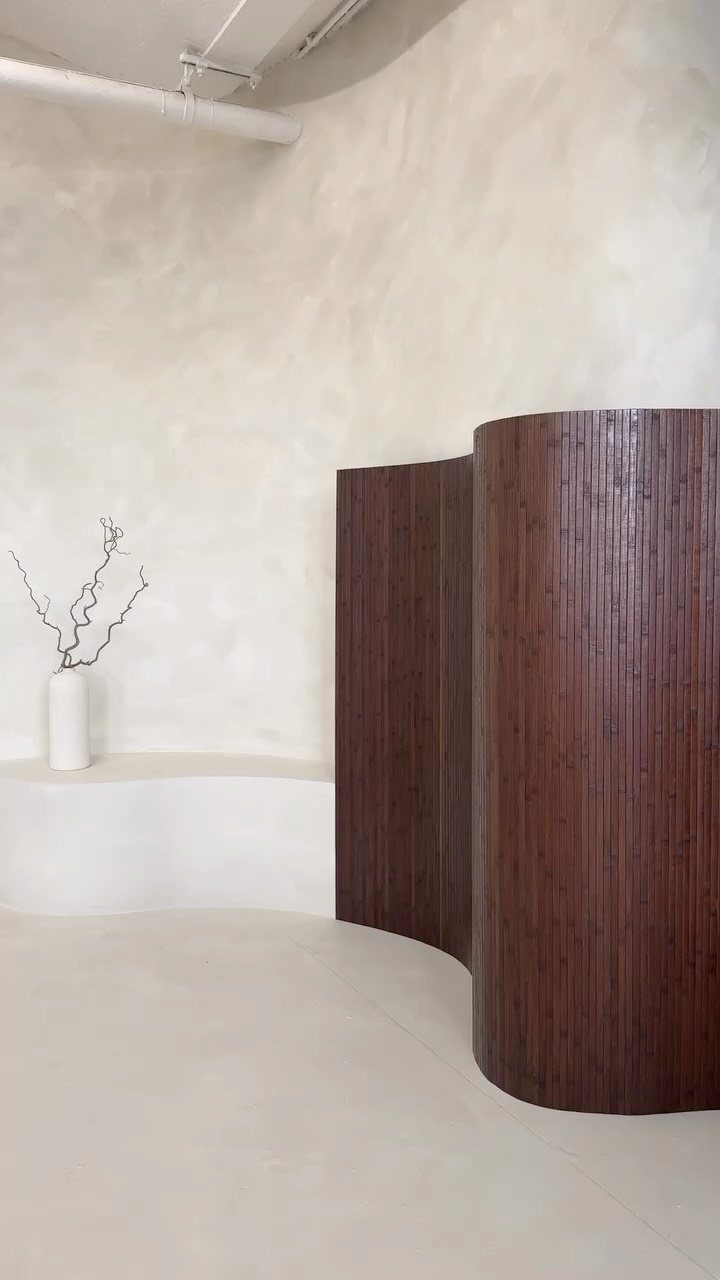
A curved run of vertical slats does something a straight wall can’t: it separates the room while the line of the curve leads the eye through it. Dark brown wood against pale walls gives a clear edge without adding clutter.
Slim, evenly spaced slats keep the divider reading as modern. Plan the curve in the layout first, because it needs more floor than a flat panel, and keep the pieces on the open side of the room clear.

Open Separation: Steel slats create a wall divider for room separation while allowing light through. The open room partition works as a room separator and provides partial separation, not full privacy.

Customizable Layouts to Expand with Your Workspace – Unlike permanent walls or cubicles, this room divider panel easily connects to our other units for adaptable layouts. Create custom configurations to match your space's needs, offering flexibility for evolving office layouts.

Open Separation: Steel slats create a wall divider for room separation while allowing light through. The open room partition works as a room separator and provides partial separation, not full privacy.
2. Zeze Room Divider

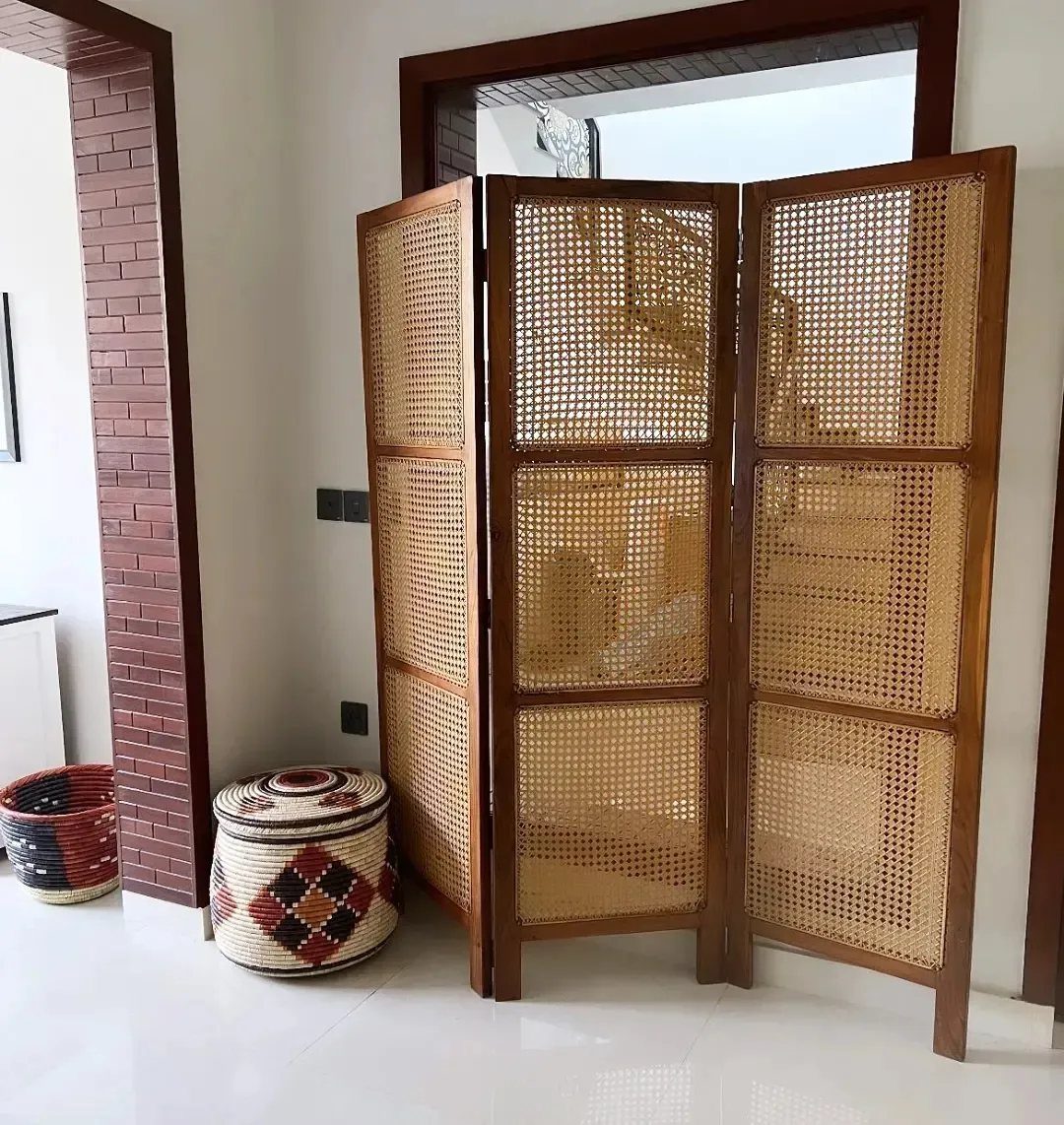
Cane webbing set into a wood frame lets daylight pass through while still marking where one zone ends. For a renter, a three-panel folding version is easier than anything built in, since it moves with you and stores flat.
I would pick this over solid panels in a small room, where blocking light makes the space feel shorter. Pair it with other woven textures, like a basket or ottoman, so the cane looks intended.

3-Panel Room Divider: The Legacy Decor freestanding privacy screen offers versatile room privacy and separation for any space. It adds cultural elegance and seamlessly complements various contemporary decor styles, enhancing the atmosphere and charm of any room.

Natural Wood and Fiber: Our folding screen is hand woven with natural plant fiber dyed with vivid color. The durable Scandanavian Spruce frame ensures long-lasting performance and is light enough to move and store easily. The woven design allows light and air to pass through, as it is not completely opaque.

Stunning Art Prints: Bring the beauty of classical Chinese art indoors with a high resolution print. Printed with fade-resistant, high color saturation ink, showcase vibrant images that serve as powerful visual focal points for your room
3. Duane Room Divider
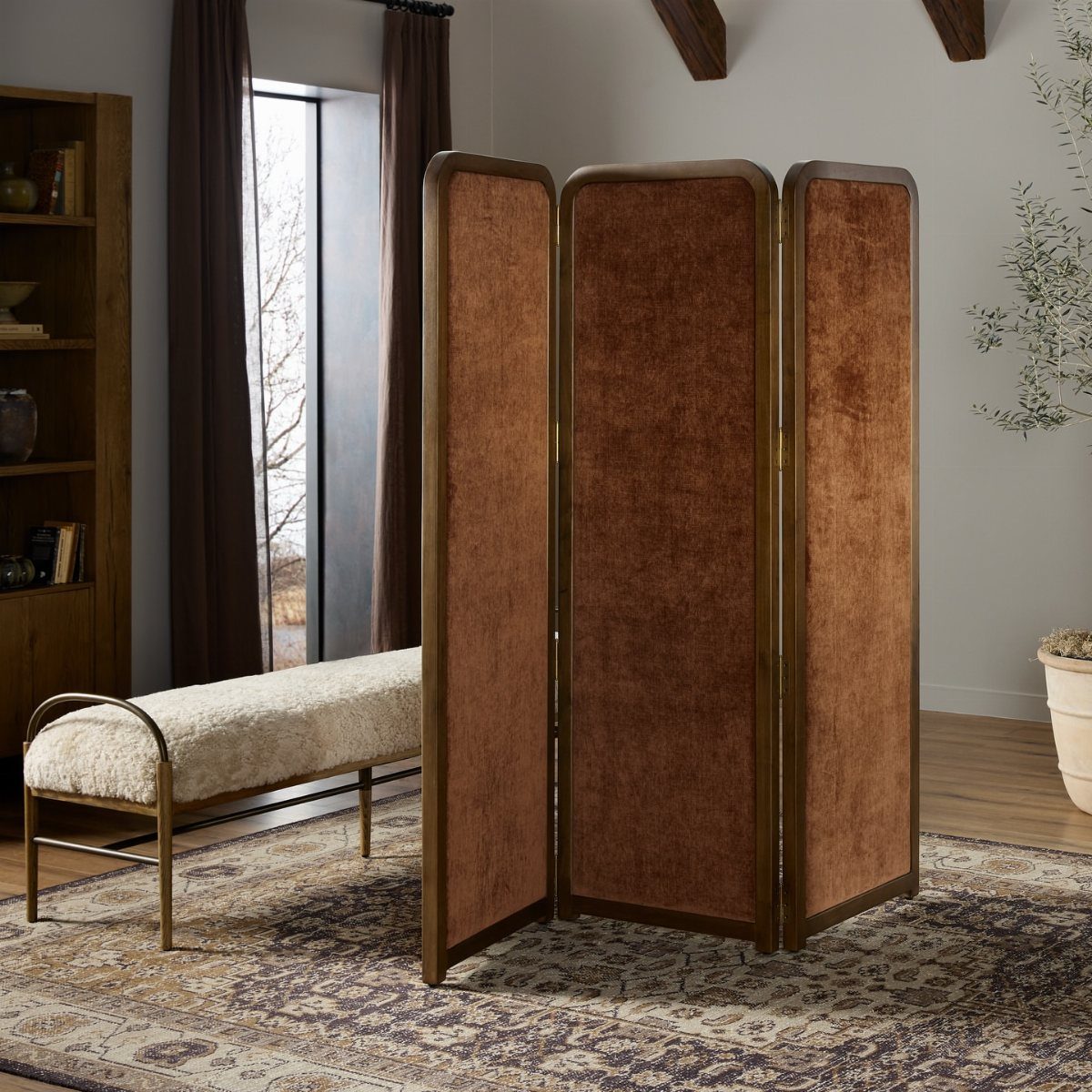
Two finished faces make a divider worth owning when both sides of it are seen, such as a bench side on one end and a sitting area on the other.
A solid wood frame with fabric panels gives it weight, so it stays put instead of wobbling.
Brown fabric in a dark frame reads calm and a bit formal. It suits a rug-anchored seating area, and I would set it along the rug’s edge to define the zone.
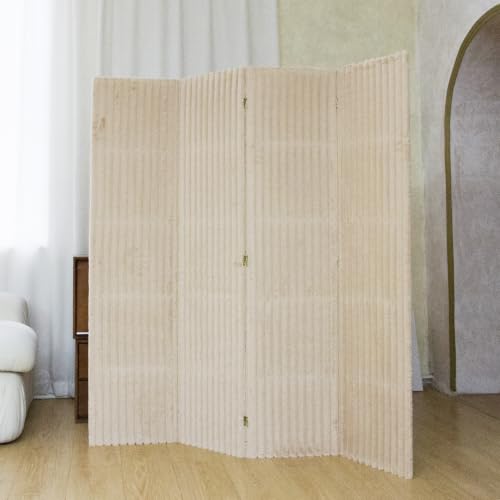
Effortless Setup & Space-Defining Design: This 4-panel velvet room divider unfolds to 67" H × 63" W, instantly defining large spaces while adding a soft, luxurious touch. Each 15.75" wide panel flexibly adapts to your layout—no tools, no hardware, no hassle. Simply unfold and position it wherever you need a stylish visual anchor.

Effortless Setup & Space-Defining Design: This 4-panel velvet room divider unfolds to 67" H × 63" W, instantly defining large spaces while adding a soft, luxurious touch. Each 15.75" wide panel flexibly adapts to your layout—no tools, no hardware, no hassle. Simply unfold and position it wherever you need a stylish visual anchor.

Stable Structure: Our Room Partitions and Dividers is made of strong steel frame with powder coating, which is not easy to scratch and rust, extending the service life. Extra Longer and Wider Feet pads fits more easily to the ground and improve the stability of the room divider and not easy to shake and fall
4. Vintage Wood Screen

Glass panes in a white wood frame give privacy without a solid wall, which suits a living room that needs a quiet corner but can’t lose its light. Mid-century lines keep it from looking heavy.
A distressed finish hides scuffs well, a real plus on a budget. If you shop secondhand, check that each pane sits snugly in its frame and the hinges swing freely before you buy.


Quality made: This 16x20 picture frame is made of engineered wood, also known as MDF, not solid wood, pack of 1.

Quality made: This 11x14 picture frame is made of engineered wood, also known as MDF, not solid wood, pack of 1.
5. Haddis Panel Room Divider

Irregular cutouts are what make this panel work: light breaks into patterns across the floor and wall, and the screen never feels like a barricade.
Carved openwork in a saturated color such as teal can carry a plain room on its own.
Keep the surroundings quiet, with a plain wall and little else nearby, so the carving gets the attention. A folding screen like this also works as a backdrop in a corner.

CARVED ROOM DIVIDER WITH 4-TIER SHELVES: More than a traditional folding privacy screen, this 4-panel carved room divider features a side shelving unit with four open tiers for framed photos, small potted plants, books, baskets and decorative accents.

Elegant Hand-Carved Design – Beautifully crafted wooden room divider with decorative hand-carved patterns adds a sophisticated touch to any space. Each panel Height 54 Inch and Total Width 64 inch( 16x4=64 inch)

Elegant Hollow Carved Appearance: Our 6 panel wooden room divider boasts delicate hollow floral cutout craftsmanship. Serving as both a space partition and attractive home decor, the openwork structure lets soft natural light filter through and delivers an elegant vintage vibe to every room
6. Noren Japanese Cloth Room Divider

A noren is the lightest kind of divider there is: a hanging cloth panel, usually split down the middle, that you walk through instead of around.
It fits a doorway or wide opening, and a two-tone fabric adds a bohemian note without much cost.
Hang it from a tension rod for a rental, since that means no drilling. Choose a length that clears the floor so it moves freely when someone passes.

Open Separation: Steel slats create a wall divider for room separation while allowing light through. The open room partition works as a room separator and provides partial separation, not full privacy.

【Customized Privacy & Light Control】 Transform your open space with our 360-degree rotating slat hardware. Easily adjust the angle of each wooden slat to achieve the perfect balance between natural light and personal privacy. Ideal for creating stylish partitions in living rooms, bedrooms, or modern offices.

🔄 INDEPENDENTLY ROTATING PRIVACY SLATS: Each vertical panel can be individually adjusted to control privacy, visibility, airflow, and natural light, allowing you to easily transition between open, partially screened, and more private room configurations.
7. Open Shelving Unit

A shelving unit that stands between zones lets you divide a room and gain display space in one piece.
Glass shelves in a slim gold frame keep sight lines open, so the sofa side and the far side still feel connected.
Place it with its back to the seating area and style both faces, since someone will see each one.
Group plants and a few frames on the shelves and leave gaps; a packed unit turns into a wall and loses the point of being open.

Environmentally Friendly : From the selection of raw materials to the output of finished products, the entire production process strictly follows the environmental protection route.

Ready-to-Use & Dimensions - Fully expanded, measures 47.2 inches tall by 47.2 inches wide (3.9 FT x 3.9 FT) | Each panel width: 15.75"W. Freestanding, no-assembly design allows for immediate placement and instant enhancement of compact areas.

Move and Store Freely:This 3 panels office room divider is lightweight and foldable, so it's easy to store without taking up much space. Also it is flexible, and you can change or move it freely. Single room partition size:71"(H)×34"(W),wall divider maximum size:102" W x 20" D x 71" H.
8. Metal Grid Partition

Thin metal bars set in a grid give a room an edge without taking away any light.
A painted blue frame works like a piece of graphic art standing on the floor, which makes it a good fit for a room with white and pale wood.
I would choose a bold color over black if the rest of the room is neutral. Keep the grid openings fairly large and the lines thin, because a tight, heavy grid starts to feel like a cage.

Effortless Setup & Space-Defining Design: This 6-panel velvet room divider unfolds to 67" H × 94.5" W, instantly defining large spaces while adding a soft, luxurious touch. Each 15.75" wide panel flexibly adapts to your layout—no tools, no hardware, no hassle. Simply unfold and position it wherever you need a stylish visual anchor.

High quality wood and fabric covered room divider. Constructed with extra durable kiln dried Spruce wood frame panels, and covered top to bottom, front, back, and edges with tough stretched poly-cotton blend canvas

Rantila Privacy Screen Indoor Room Divider is made of water resistant fabric, thick cloth which can very well protect your secret space.It is easy to clean and turn either direction.This room divider screen can also be placed beside the window to block out sunlight.
9. Glass Partition

Clear glass in a black frame marks the line between a living room and a home office while both rooms keep the same daylight.
Sound and visual clutter still stay on their own side, which a shelf or screen can’t promise as well.
The black grid lines do the decorating, so skip busy patterns nearby. Expect it to cost more than a fabric or wood divider, and to need fingerprint wiping now and then.

Nice frames: Designed to display 8x10in photos without mat or 5x7in with mat, set of 6.

3-Side Glass Display - 40" panoramic fireplace lets you enjoy 12 realistic flame colors and 6 brightness levels from different viewing angles. Side glass panels extend the visual effect, while the generous 4.3" log set creates a warmer, more immersive fireplace experience

[Overall Curved Design] Unique curved electric fireplace(26inches) glass surfaces combine TV console with a curved front. Compared with the flat entertainment stand and fireplace in the market, smooth and elegant lines show a more unique and stylish style.
10. Freestanding TV Unit

Slat panels with a TV set into them let the screen do double duty: it faces the living area while the back of the unit hides the bedroom side.
That makes it one of the few dividers I would call useful from the first day, not just decorative.
Open shelves beside the screen soften the bulk and give you somewhere for books and a lamp. Before you commit, work out where the cables will run, and keep the seating a comfortable distance from the screen.

Carved Boho Room Divider - Intricate openwork turns this wood room divider into functional wall art. The natural finish adds warmth to bedrooms, studios and living areas, while the decorative screen can also serve as an elegant wedding backdrop for ceremonies, receptions or photo areas.

CARVED ROOM DIVIDER WITH 4-TIER SHELVES: More than a traditional folding privacy screen, this 4-panel carved room divider features a side shelving unit with four open tiers for framed photos, small potted plants, books, baskets and decorative accents.

Leaf-Carved Design: Enhance your space with our exquisite room dividers featuring a leaf-carved design. These partition room dividers serve as both a functional room divider screen and a captivating wall divider, adding elegance to any room.
11. Wicker Screen with Shelving

Woven wicker panels with built-in shelves give a divider that is also storage, and the shelves are where it earns its place over a plain screen.
Potted plants and a few small decor pieces fit well, and the warm weave sits easily against wood floors.
Because it folds, a multi-panel version suits a renter: open it to split the room, fold it flat when you move. Keep heavy items low and light ones high so the panels stay steady.
12. Natural Branch Room Divider

Vertical branches running from floor to ceiling build a divider that looks grown rather than bought. The uneven trunks and knots give a living room an organic edge, and they sit well with a wicker chair and light wood floors.
Pick branches of similar thickness so the row reads as deliberate, and leave gaps between them so light and sight lines pass through. Since every branch differs, test the spacing on the floor before you fix anything in place.
13. Cane Screen with Magazine Racks

Horizontal metal rails across a cane screen turn a divider into a magazine rack, so the piece earns its floor space twice. The arched top softens the straight lines of a sofa and a small side table.
I would park it behind the sofa, where the racks face the reading spot and the cane lets light through. Keep the load modest: a few magazines and slim books per rail, so the folding panels stay steady.
14. Geometric Cutout Wood Screen

Tall dark wood with abstract cutouts gives a room a divider that reads as sculpture. Against concrete floors and a view of greenery, the openings frame the foliage instead of hiding it.
Place it where the cutouts line up with a window, so daylight and green show through the pattern. Dark wood is heavy visually, so I would use one tall piece rather than several, and keep nearby furniture simple.
15. Metallic Organic Folding Screen

Metal panels with irregular edges and a mottled silver and bronze finish catch light in a way wood and fabric can’t.
On a pale parquet floor and a white wall, a four-panel screen like this acts as the one shiny, sculptural piece in the room.
Stand it in a corner or at the edge of a seating area, and let it be the only metallic statement nearby.
A folding screen earns its place on hinges: stretch it across the room when you need a divider, then collapse it against a wall and the floor space is yours again.
Choosing the Right Materials
Match the material to how much privacy the spot needs. Fabric and curtains are the lightest option and soften a hard-edged room, wood slats give a firm edge with partial sight lines, and black metal frames read crisp and graphic.
Carved screens fall in between: they hide less than a solid panel but still mark the boundary.
Stay with neutral or natural tones if you’re unsure. Wood, rattan and oatmeal fabric blend into most rooms and won’t clash if you repaint or move.
Pick one main material and let a second one appear only as an accent. Slats with a few plants on open shelves look planned; wood, metal, fabric and rattan all in one divider look like a clearance aisle.
Maximizing Light and Space
Test any divider for light before you buy.
Stand where the divider will go, hold your hand near a window, and ask whether the zone behind it would still get daylight. If the answer is mostly no, choose something more open.
Slats and open shelving both work as floor-to-ceiling screens because the gaps pass light and keep a view through. Narrower gaps give more privacy; wider ones feel airier.
Light-toned wood helps too, since it reflects daylight instead of absorbing it. Put the divider at a right angle to the window, not across it, so the brightest part of the room stays shared between both zones.
DIY Options
A thrifted folding screen is the easiest start. Look for a sturdy frame, then replace or recover the panels in a fabric you like, since a linen-type cover can make an old screen feel intentional.
If you build, keep the design simple: a repeated element, like evenly spaced slats or identical panels, looks custom without advanced joinery. Cut everything to the same size and the result will read as a design choice.
Thrifted doors, shutters or old window frames can also be hinged together into a freestanding screen. Sand, prime and paint them one color so the mismatched parts look like one piece.
Measure your floor space first, and check that the finished piece stands steady on its own.